Decoding the Virality of Unexpected Products on TikTok
A strangely shaped scrubber, a compact sealing tool, a miniature printer, or a container that solves one oddly specific problem can remain unnoticed for years and then become nearly unavoidable on TikTok. The object may not be new, patented, or attached to a famous brand. What changes is its position inside a fast-moving system of demonstration, reaction, imitation, and personalized distribution. Understanding Decoding the Virality of Unexpected Products on TikTok therefore requires more than asking whether an item is useful. It requires examining why a particular video makes the item easy to notice, easy to explain, and easy for other people to repeat.
TikTok product virality is best treated as an event rather than a permanent quality. A product becomes viral when a recognizable story about it moves rapidly through overlapping communities. The story may be practical—“this fixes an annoying task”—or emotional—“I cannot believe this exists.” It may also be social: viewers want to tag a friend, test the claim, expose a flaw, or recreate the same reveal. The recommendation feed then turns those small reactions into new distribution opportunities.
No single formula guarantees that an obscure consumer good will spread. Platform systems are dynamic, audience interests shift, and the same clip can perform differently at another time. Still, recurring patterns reveal why unusual products often have an advantage: they create a curiosity gap, produce visual proof, invite participation, and fit into a loop where human attention and machine ranking continually respond to one another.
Virality belongs to the video-product relationship
People often speak as though a “viral product” contains a special property that inevitably attracts millions of views. In reality, virality belongs to the relationship between an object and its presentation. A drawer divider is visually ordinary until a clip opens on a chaotic drawer and resolves the mess in seconds. A cleaning attachment is forgettable until a close-up reveals debris emerging from a place viewers assumed was already clean. The product becomes meaningful because the video organizes it into a problem, an action, and a payoff.
This distinction explains why old products can suddenly appear new. TikTok does not require novelty in the manufacturing sense. It rewards novelty in the viewing experience. A familiar household item can be reframed through an unexpected use, an extreme close-up, a satisfying sound, an unusual scale, or a comparison that reveals a feature most people had never noticed.
Timing also changes the meaning of an item. A compact organizer may spread during back-to-school season. A lint-removal tool may rise during a wardrobe-cleanout trend. A portable fan may become culturally visible during a heat wave. The product's basic function remains stable, but its relevance becomes easier to communicate because a larger conversation is already active.
For this reason, views should not be interpreted as a permanent verdict on product quality. A viral moment indicates that a message traveled efficiently under particular conditions. It does not establish durability, safety, value, or long-term satisfaction.
Unexpected objects create a powerful curiosity gap
An unfamiliar object gives a short video a built-in question. Viewers see an odd shape, hidden mechanism, or unexplained movement and pause to discover what it does. That brief pause matters because the clip has gained time to deliver the answer. The most effective objects have actions that can be resolved quickly: they unfold, seal, scrape, dispense, compress, rotate, reveal, or transform.
Familiar products can still spread, but they need a second source of surprise. The surprise may come from a hidden feature, a dramatic failure, a counterintuitive use, or an unusually clear comparison. The real viral unit is not the object alone. It is the distance between what the viewer expects and what the video reveals.
Emotion helps move the content beyond passive watching. Research in the Journal of Marketing Research found that useful content and content associated with activating emotions were more likely to be shared in the news environment studied. Applied cautiously to product videos, the finding suggests that high-arousal emotions can increase sharing. Awe, amusement, relief, anxiety about a problem, and disbelief can all give viewers a reason to send the clip to someone else.
Unexpected objects are also easy to discuss. A viewer can share the video with a message such as “Why does this exist?” or “This would solve your cabinet problem.” The recipient does not need background knowledge because the demonstration carries its own explanation. This low communication cost is one reason narrow, peculiar products can move across communities that would never search for them directly.
The recommendation feed lowers the follower barrier
On a follower-centered platform, a creator usually needs an existing audience before a product demonstration can travel far. TikTok's recommendation-centered experience changes that starting condition. A clip from an unknown account can reach people because the system predicts that the content matches their interests, not because they intentionally subscribed to the creator.
Researchers have described this experience through the concept of the algorithmized self. The feed seems to mirror a person's tastes, habits, humor, identity, and current concerns, while every pause, replay, search, like, skip, and share supplies more information about what may hold attention next. A product video can therefore find a receptive niche even when the creator has little public visibility.
The same clip may belong to several interest clusters at once. A video showing a device that removes crumbs from a car can be interpreted as cleaning content, automotive content, satisfying content, organization content, or problem-solving content. That overlap increases the number of possible routes through which the video can be tested with new viewers.
Interview research on TikTok has also shown that human and machine agency shape one another. Users attempt to train or resist the feed through their behavior, while recommendations influence what they watch, search for, discuss, and create. Product virality emerges from this feedback loop. The algorithm does not invent curiosity, but it can locate and repeatedly expand the audiences in which curiosity appears strongest.
Ethnographic research has further observed that the For You Page becomes part of everyday routines. Routine scrolling gives unfamiliar objects repeated chances to become recognizable. A viewer may ignore the first appearance, watch the second, and interpret the third or fourth as evidence that a broader trend exists. Recognition itself becomes part of the viral effect.
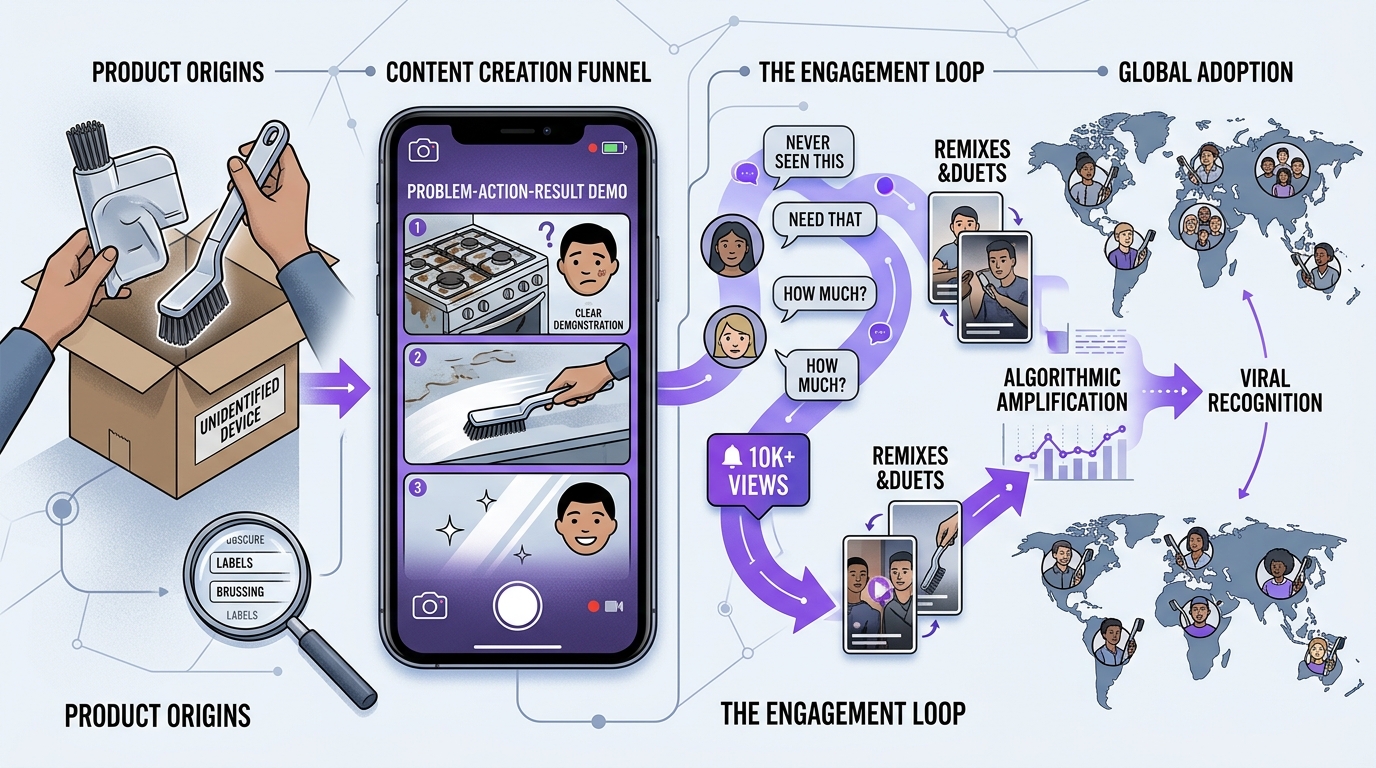
Visual map: the journey from obscure object to viral product story
The hook-proof-payoff structure compresses persuasion
Many successful product clips follow a compact narrative. The hook presents a problem or mystery. The proof shows the object performing a visible action. The payoff reveals a result that is easy to compare with the opening. This structure reduces the amount of explanation needed and allows the viewer to evaluate at least one claim with their own eyes.
The hook often appears before the product is named. A stain, cluttered shelf, tangled cable, awkward reach, or unexplained tool can stop the scroll because the viewer wants closure. Showing the most confusing or visually intense moment first is not simply decoration; it creates an unresolved question that the rest of the clip promises to answer.
Proof is strongest when the action is observable and bounded. A ten-second demonstration that a brush reaches a narrow gap is clearer than a broad statement that the brush makes an entire home cleaner. A visible seal, measured quantity, captured debris, or side-by-side surface gives the viewer a specific outcome to judge.
The payoff should be legible on a small screen. Strong contrast, close framing, stable camera placement, and one dominant movement usually communicate more effectively than a wide scene filled with distractions. Creators may use a phone tripod, overhead phone mount, portable LED light, neutral tabletop backdrop, clip-on microphone, or rotating display stand to make a demonstration clearer. These tools do not manufacture virality, but they can reduce visual and audio ambiguity.
Looping strengthens the structure. When the final image resembles the opening frame, the restart feels natural, and some viewers watch again before realizing the clip has repeated. Rewatching may reflect fascination, confusion, close inspection, or a desire to confirm what happened. Those motivations are different, but each keeps attention on the content longer.
Comments become a collaborative production system
Comments do more than record audience opinion. They generate new experiments. Viewers ask whether the product works on another material, request a durability test, identify a possible hazard, challenge the setup, or suggest a more extreme use. A creator can answer with a reply video, turning one demonstration into a continuing series.
This process allows the audience to help write the content calendar. One viral object may produce tests, debunks, cleaning instructions, failure videos, comparisons with older methods, and reactions from people in specialized occupations. Each variation introduces the product to another audience while keeping the original visual language recognizable.
Visible reactions also shape interpretation. A large randomized experiment published in Science found that prior positive ratings can influence later evaluations in an online community. TikTok likes and comments are not identical to that experimental setting, but the general principle is useful: viewers do not judge a clip in isolation. They encounter accumulated approval, skepticism, humor, and repetition before forming their own response.
Negative attention can be highly distributable as well. A creator may criticize an unsafe demonstration, expose an editing trick, or show that the object fails under ordinary conditions. The product remains culturally visible even as its reputation changes. Engagement therefore cannot be treated as a synonym for endorsement.
Imitation transforms an object into a cultural template
A single demonstration may attract viewers, but a repeatable format creates a trend. TikTok's participatory features allow people to reproduce an idea without inventing a new genre. They can adopt the same audio, caption pattern, opening shot, reveal, or challenge and substitute their own room, problem, personality, or result.

The product becomes a prop inside a shared script: “testing the viral gadget,” “things I did not know existed,” “does it actually work,” or “the tiny tool that fixed this annoying problem.” The script lowers the creative barrier. New participants already know the expected sequence, and viewers already know how to interpret it.
Replication can act as informal verification. When many unrelated users show similar outcomes under different conditions, confidence may grow. However, repetition is not automatically independent evidence. Creators may copy the same favorable setup, use identical editing, repeat a campaign brief, or obtain the same sample from a coordinated promotion. Ten similar clips can create the appearance of confirmation while testing very little.
True variation is more informative. Different surfaces, time periods, users, environments, and failure conditions reveal whether the claimed benefit survives outside the original demonstration. A trend becomes more credible when it includes honest limits rather than only perfect recreations.
Visual study: the human-algorithm feedback loop behind product virality
The hidden-gem narrative creates identity and urgency
Unexpected products frequently arrive through a discovery story. The creator presents the object as overlooked, secret, professional-only, foreign, discontinued, or strangely absent from mainstream stores. This framing turns attention into identity. Sharing the clip allows the viewer to become the informed friend who found the solution before everyone else.
The phrase “hidden gem” also makes an ordinary function feel culturally new. A basic organizer becomes a small-space hack. A maintenance tool becomes the device professionals supposedly keep to themselves. A travel container becomes a packing secret. Language does not change the object, but it changes the social reward attached to knowing about it.
Urgency often follows recognition. Comments may report sellouts, changing listings, unavailable colors, or sudden restocks. Some scarcity is real because a small supply chain can be overwhelmed by rapid attention. Other scarcity is inferred from repetition or emphasized to accelerate action. A crowded comment section can make delay feel risky even when the product category is widely available under many names.
Casual production style reinforces the discovery narrative. Imperfect lighting, conversational speech, an ordinary room, and visible surprise can make the clip feel independent. Yet informality is an aesthetic, not evidence. A sponsored or affiliate-linked post can look spontaneous, and a genuinely independent post can look polished.
Why the same object suddenly appears everywhere
The feeling that “everyone is posting this” usually combines two effects. First, more creators produce variations because they can see the format gaining attention. Second, the viewer's own interactions lead the recommendation system to supply more related clips. Increased production and personalized exposure reinforce each other.
Repeated exposure changes the psychological status of the object. It moves from unknown to familiar, from familiar to trend-associated, and sometimes from trend-associated to apparently normal. A product that looked ridiculous on first contact may seem plausible after many demonstrations, especially when the clips come from people with different identities and settings.
This recognition cascade does not require every viewer to approve. Some people watch because they are curious, skeptical, amused, or annoyed. The system can still interpret their behavior as evidence that the topic holds attention. Controversy can therefore broaden distribution even when sentiment is mixed.
Virality is also unevenly visible. Two people can use the same app and experience completely different product cultures. One may see kitchen organizers repeatedly, while another sees cycling tools, beauty devices, repair materials, or no consumer demonstrations at all. “Everywhere” often means everywhere inside a particular recommendation environment.
What causes product virality to stall or reverse
Most imitations of successful product clips never become widely visible. The opening may be too slow, the outcome difficult to see, or the problem too specialized. The object may require a long explanation, professional skill, unusual preparation, or conditions that cannot be reproduced in an ordinary home. Without a clear payoff, curiosity does not convert into sharing.
A trend can also exhaust its surprise. Once viewers understand the mechanism, another identical reveal adds little information. Creators then need a new test, a failure, an extreme condition, a different audience, or a meaningful comparison. Without variation, the template becomes predictable and attention moves elsewhere.
Offline friction matters. A product may have inconsistent versions, confusing generic names, uncertain materials, regional availability problems, or weak instructions. Rapid demand can expose quality-control differences that were less visible when the item sold in small quantities. The viral story may remain simple while the real product category becomes increasingly complicated.
Contradictory evidence can reverse the trend's meaning. If independent users show hidden preparation, unsafe use, selective editing, or poor durability, the object may remain famous but stop being admired. Virality can survive the collapse of trust because debunking and argument create their own content loop.
Explanatory table: the mechanics behind sudden product fame
| Mechanic | What the viewer experiences | Why it can spread | What it does not prove |
|---|---|---|---|
| Curiosity gap | An unfamiliar object or unresolved problem | Encourages the viewer to wait for an answer | That the result will matter after novelty fades |
| Visible transformation | A clear before, action, and after | Communicates a claim with little explanation | That the setup represents normal use |
| Activating emotion | Surprise, relief, amusement, concern, or awe | Creates energy for sharing and tagging | That the underlying claim is accurate |
| Interest-cluster routing | Relevant content from an unfamiliar creator | Reduces dependence on an existing follower base | That distribution is stable or predictable |
| Social proof | Large counts and repeated positive reactions | Signals that attention may be socially important | That attention equals quality |
| Participatory template | A script that is easy to test, copy, or parody | Generates many related videos around one object | That copies are independent tests |
| Hidden-gem identity | The feeling of discovering something early | Turns sharing into social currency | That the item is genuinely rare or new |
| Scarcity narrative | Concern that access may disappear | Compresses the time available for reflection | That scarcity is real or lasting |
A practical checklist for analyzing a viral product trend
- State the exact claim: Describe what the clip visibly demonstrates without repeating broad promotional language.
- Separate the object from the edit: Look for cuts, time compression, changed camera angles, off-screen preparation, and different lighting between the opening and payoff.
- Identify the curiosity gap: Ask which unanswered question kept viewers watching.
- Compare independent variations: Favor tests using different users, surfaces, conditions, and time spans over copies of one script.
- Read critical comments: Questions about materials, cleaning, maintenance, electrical safety, food contact, children, pets, and durability often expose missing context.
- Check the timeline: Determine whether the surge is new, seasonal, revived, or based on recycled footage.
- Map the audience bridge: Identify the niche that first cared and the emotion or usefulness that made the clip understandable outside that niche.
- Inspect disclosures: Look for paid partnerships, gifts, affiliate relationships, employment ties, and other material connections.
- Distinguish attention from evidence: View counts measure distribution, not reliability, safety, or long-term usefulness.
- Watch the post-peak phase: Durable trends develop realistic maintenance, limits, and varied use cases; short spectacles often disappear when surprise is exhausted.
Frequently asked questions
Does the algorithm decide which products become viral?
The recommendation system affects distribution, but it does not act alone. Viewer attention, creator framing, repeatability, cultural timing, private sharing, and follow-up content all contribute. The system can expand a clip that produces strong signals, yet people create and interpret those signals.
Why do generic or inexpensive products often spread quickly?
They are frequently easy to demonstrate, available under many listings, and simple for other creators to obtain and recreate. Their generic nature can accelerate imitation, but it also creates uncertainty because different versions may use different materials or manufacturing standards.
Is a high view count evidence that a product works?
No. A high view count shows that a video attracted and retained attention. That attention may come from usefulness, spectacle, controversy, humor, confusion, or criticism. Reliability requires realistic testing, consistent product identification, and evidence over time.
Why do I see the same product repeatedly after watching one video?
Your watch behavior may signal interest, while creators may simultaneously be producing more variations of a rising format. Personalized recommendation and increased supply combine to create the impression that the product has taken over the entire platform.
Can negative reviews make a product more viral?
Yes. Debunking, disappointment, parody, safety concerns, and arguments can all generate comments, replies, searches, and new tests. Negative virality raises awareness while potentially lowering trust, so visibility and approval should be evaluated separately.
Why do creators use almost identical phrases and camera angles?
Successful structures become templates. Creators copy openings, sounds, captions, framing, and reveal sequences that audiences already understand. Some copying is organic participation; some may reflect campaign instructions, affiliate communities, reposting, or imitation of a leading clip.
How long does a viral product trend last?
There is no standard duration. A novelty can peak in days, while a useful category can cycle for months as new audiences, seasons, and use cases emerge. Trends last longer when the object supports varied demonstrations and continued discussion rather than one surprise.
What basic tools help creators document a product claim clearly?
Readable evidence matters more than an expensive studio. A stable mount, consistent light, clear sound, and uncluttered surface are often enough. Depending on the demonstration, a wireless lavalier microphone, mini photo light box, smartphone macro lens, washable filming mat, microfiber cleaning cloths, and small parts organizer may support repeatable close-up recording. They improve documentation, not the truth of the claim.
Conclusion: a product goes viral when its story becomes repeatable
Unexpected products rise on TikTok when several systems align. The object creates a question. The video converts that question into visible proof. Emotion gives viewers a reason to share, while comments supply new experiments and arguments. Repetition makes the object familiar, and personalized distribution carries successful variations into new interest clusters.
The process can reveal genuinely useful ideas, but it can also magnify thin evidence. Similar clips may look like independent confirmation even when they repeat the same setup. Informal presentation may resemble neutrality even when a commercial relationship exists. Scarcity may feel like proof of value even when it only reflects temporary attention or a small supply chain.
Decoding the Virality of Unexpected Products on TikTok is therefore less about predicting the next object and more about understanding the story attached to it. The decisive question is not simply, “What does this product do?” It is, “Why has this particular demonstration become easy to watch, easy to copy, and easy to pass along at this moment?” That question reveals the cultural and algorithmic mechanics that turn an obscure consumer good into a temporary public event.


Comments
Post a Comment