Why Do Some Everyday Items Explode into Viral TikTok Sensations?
A kitchen tool, desk accessory, cleaning device, or oddly specific gadget can sit unnoticed for months and then suddenly appear in thousands of short videos. That jump is often described simply as TikTok virality, but the label hides several different processes. An item has to attract attention, communicate something quickly, give viewers a reason to care, become discoverable to people outside the original audience, and sometimes generate enough curiosity or social proof to prompt another round of sharing or searching.
The important distinction is that a viral object is not necessarily a universally superior object. A product can become highly visible because its use is easy to demonstrate, because its appearance is surprising, because viewers recognize a problem it addresses, or because the surrounding conversation makes the item unusually salient. Research on online diffusion supports several of these mechanisms, but it also shows why no single formula explains every viral episode. The strongest evidence comes from combining studies of emotion, novelty, social influence, recommendation, and product diffusion rather than treating “the algorithm” as a complete explanation.
The first ingredient is not popularity; it is legibility
For an ordinary item to become a short-video subject, viewers need to understand what they are seeing quickly. This is a different problem from proving that the object is useful. A five-second demonstration can make an unusual mechanism, transformation, sound, texture, or before-and-after contrast immediately legible. A technically impressive item that requires several minutes of explanation may have less short-form communication potential even if its underlying function is valuable.
This helps explain why some seemingly mundane objects become “trending gadgets.” Their physical properties can create a compact visual story. A storage accessory can visibly transform a messy space. A small kitchen device can demonstrate a repetitive task in seconds. A phone tripod can make a hands-free demonstration possible, while a clip-on light can make the relevant action easier to see. An overhead phone mount can change the camera angle so that an object’s function is understandable without extensive narration.
These examples should not be mistaken for a recipe for virality. They illustrate a more modest principle: the easier an object's distinctive feature is to perceive in a short clip, the easier it is for viewers to recognize why the clip exists. That recognition creates an opportunity for attention; it does not guarantee distribution.
Novelty creates a gap that viewers want to close
A familiar item can still spread, but novelty often supplies the initial question: “What is that?” Research on online information diffusion has repeatedly found that unusual or novel material can receive additional attention. In a 2021 study of more than eight million COVID-19-related tweets, Photiou, Nicolaides, and Dhillon found that informational novelty was associated with faster propagation in several topic categories. The relationship was not universal, however: the researchers also observed that different subject areas behaved differently and that average novelty could spread less than very high novelty.
That limitation matters when applying the finding to TikTok gadgets. A novel product video is not the same thing as a novel news story. The study concerns Twitter posts during a specific period of the COVID-19 pandemic, not consumer products on TikTok. Its useful contribution is therefore conceptual rather than predictive: new information can change the probability that people notice and pass along a message, but novelty does not operate independently of context.
There is another layer. Novelty often works by creating a knowledge gap. The viewer sees an unfamiliar object and wants to resolve uncertainty about what it does. That is close to curiosity, and curiosity itself can be socially influenced. In two experiments reported in Cognitive Science, Dubey, Mehta, and Lombrozo found that social popularity cues increased participants' curiosity and their willingness to seek answers. In a TikTok setting, visible engagement can therefore become part of the content environment rather than merely a score attached to it.
Emotion helps explain why a clip becomes shareable
People rarely share information for only one reason. They may share because something is funny, surprising, satisfying, useful, strange, impressive, or personally relevant. Research by Berger and Milkman on online content found that physiological arousal was an important part of the relationship between emotion and sharing: highly activating positive emotions such as awe and certain highly activating negative emotions were associated with greater virality. The implication is not that creators should manufacture extreme emotions. It is that emotionally activating material can be more likely to produce a behavioral response than material that leaves viewers completely passive.
More recent evidence adds an important qualification. Paletz and colleagues analyzed more than 4,000 multimedia Facebook posts and found associations between particular discrete emotions and sharing even after accounting for factors such as follower count, time online, topic, and reactions. The result argues against an overly simple rule such as “positive videos go viral.” Different emotions can be associated with sharing in different circumstances.
For everyday products, emotional activation can be remarkably ordinary. A tiny device that solves an irritating task may create relief. A strangely shaped tool can produce amusement. A clever mechanism can trigger surprise. A visually neat transformation can create satisfaction. None of these reactions proves product quality. They simply give viewers a reason to continue watching or communicate the experience to somebody else.
A large view count measures attention and distribution, not durability, safety, effectiveness, value, or suitability. A viral demonstration can also omit context, show an unusually favorable result, or make a narrow use case appear universal. Treat “everyone is talking about it” as evidence of visibility, not independent proof that the underlying item performs well.
Why social proof can accelerate an obscure item
Once an object receives some attention, the audience itself can become part of the explanation. A viewer may see comments asking where an item came from, another person demonstrating the same object, or a series of increasingly creative uses. These signals reduce the sense that the viewer is encountering the object alone. The item begins to look socially established even when it was obscure a short time earlier.
Academic research on social influence and adoption provides a useful foundation here. Kim and Park studied voluntary adoption of a mobile gift service and found that social influence was related to adoption, including characteristics and numbers of people prompting others. Separately, a 2025 Journal of Consumer Research study of an online peer-to-peer game found informational peer effects from anonymous peers, with stronger effects among less-experienced participants. That second finding is especially relevant to the idea of a “hidden gem”: people do not always need to know the person making a recommendation for another person's behavior to become informative.
Yet social proof has a boundary. Seeing many people use an item can answer the question “Is this thing known?” without answering “Does this thing work for my situation?” Popularity is evidence about attention and collective behavior. It is not automatically evidence about function.
The platform changes the path from curiosity to discovery
TikTok is not simply a digital noticeboard where a creator posts and followers decide whether to pass the message onward. Recommendation systems can place content in front of people who have no prior relationship with the creator. Academic work on TikTok and short-video recommendation describes a tension between prediction and surprise: systems need useful predictions about what may interest viewers, while novelty and unpredictability can also contribute to continued attention.
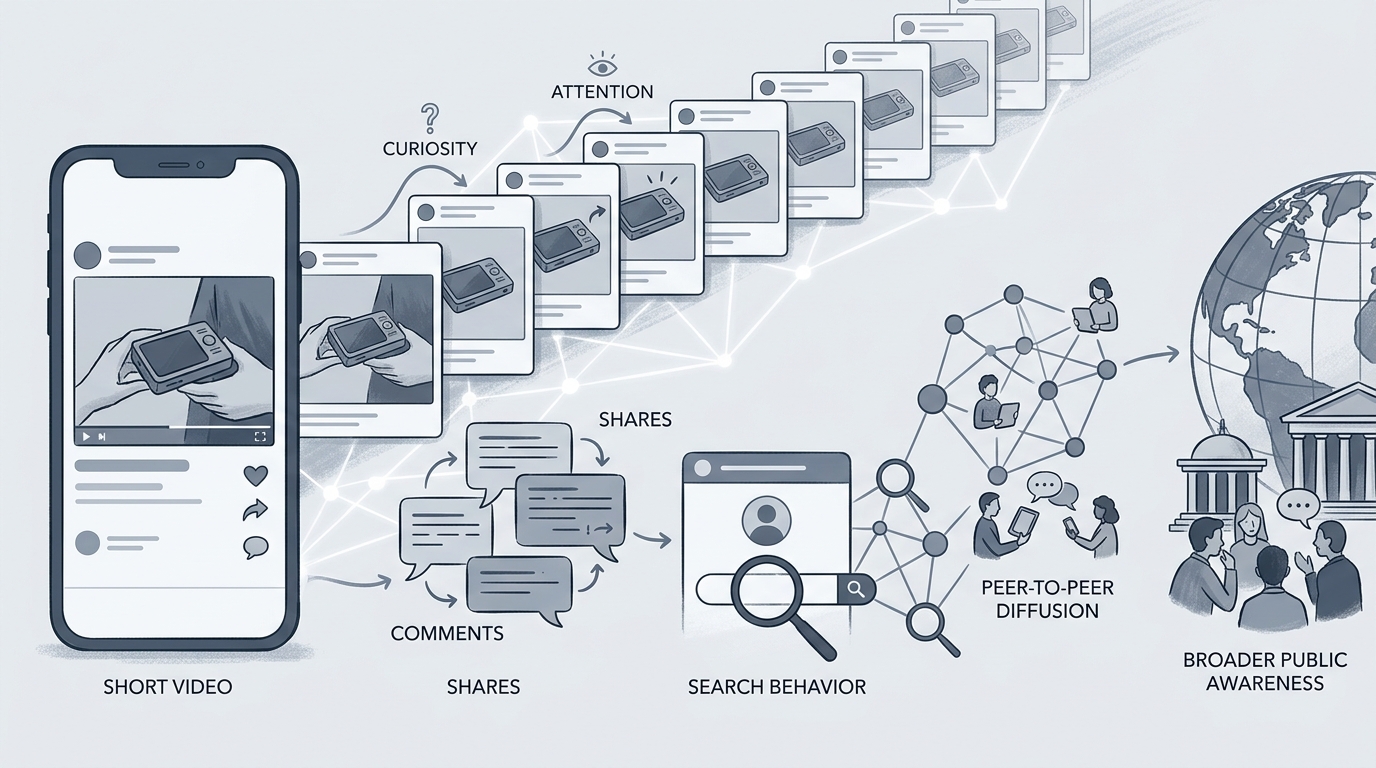
This matters because an obscure product does not necessarily require an established fan base to gain exposure. A video can function as the bridge between an unknown object and a new audience. If viewers respond, additional signals can accumulate around the content. Some viewers may watch similar videos, search the item's name, read comments, make their own clips, or explain the item to someone else.
It is tempting to describe this as a single algorithmic event: the platform “decides” to make something viral. The evidence supports a more complicated interpretation. Recommendation affects who encounters a video, but human behavior determines what viewers do after encountering it. Emotion, curiosity, social proof, prior knowledge, topic relevance, and the object's demonstrability can all interact with distribution.
Virality can move outside the original social network
One of the most useful findings for understanding “hidden gems” comes from product-diffusion research rather than TikTok research specifically. Riedl and colleagues conducted large-scale experiments involving a mobile-service product and found evidence for two interacting pathways: peer-to-peer diffusion and what they called on-demand information seeking. People could encounter information through social contacts, but they could also actively look for information online. The researchers found that these mechanisms produced highly uneven adoption, with some seeded information spreading dramatically while most did not.
The broader lesson is important. A viral item does not have to travel in one continuous chain from creator A to follower B to follower C. Someone may discover the item through a video, independently search for it later, encounter another demonstration, discuss it with a friend, and then create a new video. The visible social-media cascade can therefore be the surface expression of several different diffusion processes operating together.
This also helps explain why “TikTok made it famous” can be an incomplete description. TikTok may be the initial discovery environment, the amplification environment, or simply one of several environments in which an item's visibility compounds. Search, comments, reposts, other platforms, and offline conversations can all create additional entry points.
The hidden variable is often the audience's problem
Many viral gadgets appear to solve a small problem that people recognize immediately. The problem does not have to be dramatic. It can be a repetitive kitchen task, an awkward cable arrangement, a hard-to-see camera angle, a cramped storage space, or an annoying cleaning step. When the viewer already understands the problem, less explanation is required before the demonstration becomes meaningful.
This creates a useful distinction between object novelty and problem familiarity. A product may look strange while solving a familiar problem. That combination is particularly easy to communicate: “I have this problem, and I have never seen this mechanism.” Conversely, a completely unfamiliar product addressing an unfamiliar problem may need much more explanation before viewers understand why they should care.
That is one reason an obscure item can suddenly become recognizable as a “hidden gem.” The object itself may not have changed. The audience's interpretation has changed because the social environment supplied a frame for understanding it.
What the evidence says about “everyone is buying it”
Popularity signals deserve special caution because they can become self-reinforcing. Research on adoption information shows that knowing how many other people have adopted something can affect later adoption, but the effect depends on uncertainty and similarity between people. In other words, a large visible audience is not equally persuasive in every context.
The same principle applies to TikTok comments and repeated demonstrations. If a viewer has little knowledge about a product category, other people's behavior may provide useful information. If the viewer already understands the category well, the same social signal may add less information. This is consistent with research showing that informational peer effects can be stronger among less-experienced participants.
So the phrase “everyone is buying it” should be interpreted carefully. It can describe a genuine increase in attention, but it can also compress several different signals into one dramatic claim. Views, comments, searches, reposts, creator participation, and actual purchases are different behaviors. Treating them as interchangeable makes the phenomenon appear simpler than it is.
A practical action checklist for reading viral gadget claims
The goal of a checklist is not to tell readers what to buy. It is to make viral claims easier to interpret without confusing visibility with evidence.
- Identify the claim: Is the video saying the object is unusual, useful, durable, transformative, inexpensive, or merely popular?
- Separate demonstration from conclusion: If a clip shows one successful use, ask whether the evidence actually supports the broader statement being made.
- Look for the problem being solved: If the problem is familiar, the item's appeal may be easier to understand than its novelty alone suggests.
- Check the social signal: Views, comments, reposts, and searches indicate different forms of attention and should not be treated as one metric.
- Consider independent information: If the claim concerns performance, safety, durability, or technical specifications, look beyond short-form social content.
- Test the scope of the claim: If X is a visually obvious demonstration, it may explain attention; if X requires hidden conditions or repeated use, consider whether the video provides enough evidence.
- Watch for repetition effects: Seeing the same object repeatedly can make it feel more familiar without necessarily providing new information.
- Distinguish trend from adoption: A topic can dominate attention temporarily without producing lasting behavior change.
Where the “viral product formula” breaks down
A useful explanation must include counterexamples. Some objects are highly demonstrable but never become widely known. Some products are genuinely useful but are difficult to show in a few seconds. Some visually spectacular items attract millions of views while generating little sustained adoption. And some products become popular because of an external event, a celebrity appearance, a seasonal need, or a coordinated campaign rather than because their physical characteristics are inherently viral.
There is also a measurement problem. Viral content is easier to observe than failed content. Researchers and audiences naturally notice the extraordinary successes, while thousands of similar videos that received little attention disappear from memory. This creates a classic selection problem: if we study only objects that became famous, almost every explanation can look persuasive after the fact.
For that reason, “this product went viral because it was satisfying” is usually better treated as an interpretation than as a complete causal finding. A rigorous explanation asks what happened before the spike, what audience saw the content, what signals changed, whether people searched or adopted the item, and whether the same pattern appeared elsewhere.
A source-led way to think about TikTok virality
The research can be synthesized into a sequence without pretending that every viral item follows it perfectly. First, an object or demonstration becomes legible: viewers can see what is distinctive. Second, it becomes attention-worthy: novelty, curiosity, emotional activation, or a recognizable problem gives viewers a reason to continue. Third, it becomes socially meaningful: comments, creators, peers, or visible engagement signal that other people are also paying attention. Fourth, it becomes discoverable: recommendation and search mechanisms expose the item to people beyond the original audience. Fifth, some viewers become active participants, creating searches, discussions, demonstrations, or additional sharing.
These stages can reinforce one another, but they can also stop at any point. An object can be fascinating without being useful. A useful object can be difficult to demonstrate. A compelling video can attract attention without generating product searches. Search activity can rise without sustained adoption. And adoption can occur without the object becoming culturally recognizable.
This layered model is more consistent with the evidence than the idea of a mysterious viral switch. Research on emotion explains part of the sharing process. Research on novelty explains part of attention and diffusion. Research on social influence explains why other people's behavior can become informative. Research on product diffusion shows that active searching can create a pathway outside ordinary social ties. TikTok-specific scholarship adds the role of recommendation, prediction, and surprise. None of these pieces alone explains every viral gadget, but together they show why an ordinary object can become unusually visible.
FAQ: everyday items and TikTok virality
1. Does TikTok virality mean an item is genuinely useful?
No. Virality primarily describes visibility and diffusion. A viral demonstration may show genuine utility, but views and shares do not independently establish durability, effectiveness, safety, or suitability for every user.
2. Why do ordinary objects sometimes become trending gadgets?
Ordinary objects can become attention-worthy when their distinctive function is easy to demonstrate, their appearance creates curiosity, or they solve a familiar problem in an unfamiliar way. Social proof and recommendation can then expose the demonstration to additional audiences.
3. Is novelty the main reason products go viral?
Novelty is one possible contributor, not a complete explanation. Research on online diffusion finds that novelty can increase propagation in some contexts, while other studies show that emotion, social influence, information seeking, and contextual factors also matter.
4. Does the TikTok algorithm create viral products?
Recommendation systems can influence who encounters content, but describing virality as an algorithm-only process leaves out human behavior. Viewers decide whether to watch, comment, search, share, demonstrate, or ignore an item, and those behaviors can create additional diffusion pathways.
5. Why can a strange product suddenly seem familiar?
Repeated exposure can change the social context around an object. When viewers encounter several demonstrations, comments, and discussions, an unfamiliar item can become recognizable even if they have never encountered it offline.
6. Can social proof make people more curious?
Experimental research in Cognitive Science found that social popularity cues increased curiosity in the studied setting. That supports the general idea that visible interest can influence attention, although it does not establish a specific TikTok product effect.
7. Why do some viral items disappear quickly?
Attention and adoption are different processes. A novelty-driven clip may be highly engaging for a short period, while an item that requires repeated use or solves a narrow problem may not sustain the same level of discussion. Seasonal events and changing audience interests can also alter diffusion.
8. What is a “hidden gem” in social-media culture?
In this context, a hidden gem is an item that was relatively obscure to a particular audience before social exposure made its function recognizable. The phrase describes perceived discovery status, not an independently verified judgment about product quality.
Information-synthesis conclusion: virality is a chain, not a switch
The most revealing part of a viral TikTok gadget is often not the object itself but the chain of interpretation surrounding it. An ordinary item becomes a potential story when its function is easy to perceive. Novelty can create the initial question. Emotion can make the experience more shareable. Social signals can make the question feel more important. Recommendation systems can place the story before new viewers. Search can carry the object beyond the original network. New demonstrations can then create another cycle of attention.
At the same time, the evidence argues against treating these mechanisms as guarantees. Studies of Twitter, Facebook, online games, mobile services, and product diffusion illuminate parts of the process, but they are not interchangeable with a controlled study of every TikTok trend. The strongest conclusion is therefore narrower and more useful: TikTok virality emerges from interactions among content characteristics, human attention, social information, recommendation, and active discovery.
That framework explains why a previously obscure gadget can suddenly look as though it appeared everywhere at once. The object may be unchanged; what changed is the number of pathways through which people can notice it, interpret it, discuss it, search for it, and reproduce its story. Understanding that distinction makes viral culture easier to analyze—and makes it less tempting to confuse a flood of attention with proof of anything beyond attention itself.
Research note: The evidence synthesized here comes from peer-reviewed research on online sharing, novelty, curiosity, social influence, recommendation systems, and product diffusion. Several studies examine Facebook, Twitter, online games, or other adoption settings rather than TikTok specifically. Those scope differences are retained because they are important limitations when interpreting the broader phenomenon.


Comments
Post a Comment